Not long ago, a sharp first-draft analysis cost you a graduate, a week and a slice of the consulting budget. Today it costs a few cents and about thirty seconds. Your competitors pay exactly the same price.
Stanford's 2025 AI Index put a number on it. The cost of running an AI model that performs at roughly GPT-3.5 level fell from about US$20 per million tokens in November 2022 to about seven cents by October 2024. More than 280 times cheaper, in under two years.
Access to knowledge, or at least a very fluent version of it, is now a utility. Facts, summaries, frameworks, a passable first draft on almost anything.
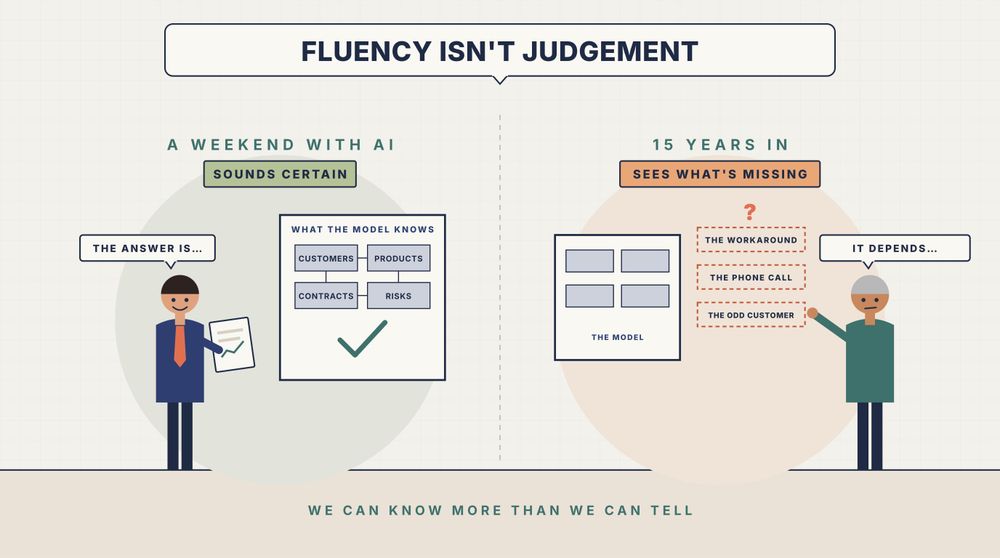
That isn't the same as intelligence. Intelligence is knowing what to do with knowledge in your particular situation, and that hasn't got any cheaper.
We've seen this film before
In 2003 Nicholas Carr wrote a Harvard Business Review article with a deliberately provocative title: "IT Doesn't Matter". His argument was that once a technology is available to everyone, like railways or electricity, it stops being a source of advantage. Still essential, but no longer what sets you apart.
Plenty of people pushed back, and they had a point: what matters is how you use it. Which is exactly the point.
In my piece on Wardley mapping, I wrote that every technology travels the same road, from novel and expensive to a boring utility nobody thinks about, and that large language model access was making that journey fast enough to watch in real time. It has.
So where did the value go?
Clayton Christensen had an answer. In The Innovator's Solution (2003, with Michael Raynor), he described the law of conservation of attractive profits. When one link in the value chain becomes a commodity, the value doesn't vanish. It moves to the link next door.
So if knowledge is cheap, what's next door?
Herbert Simon saw the pattern in 1971: "a wealth of information creates a poverty of attention." Swap information for knowledge and it holds even better. When anyone can generate a strategy paper or a risk assessment on demand, the scarce things become:
- knowing which question is worth asking
- context nobody else has: your customers, your history, your constraints
- the judgement to tell a good answer from a fluent one
- someone accountable for acting on it.
The trap
This is where a few of my earlier pieces meet. AI raises the floor on output, but not on judgement. Hand over the thinking and the judgement behind it quietly fades. And when an answer costs nothing, every problem starts to look like a question for the AI. Cheap knowledge makes a very persuasive hammer.
The result is organisations producing more analysis than ever, while fewer people can say what it means, or who actually decided.
Three moves for leadership teams
Stop counting outputs. If papers are free, more papers isn't progress. Ask what decision each one is for, and what would change your mind.
Invest next door. Put the money and senior attention into what doesn't commoditise: your own context and data, your relationships, and the people who can frame the problem well. Work out which capabilities you actually need, and in what order, before buying another licence.
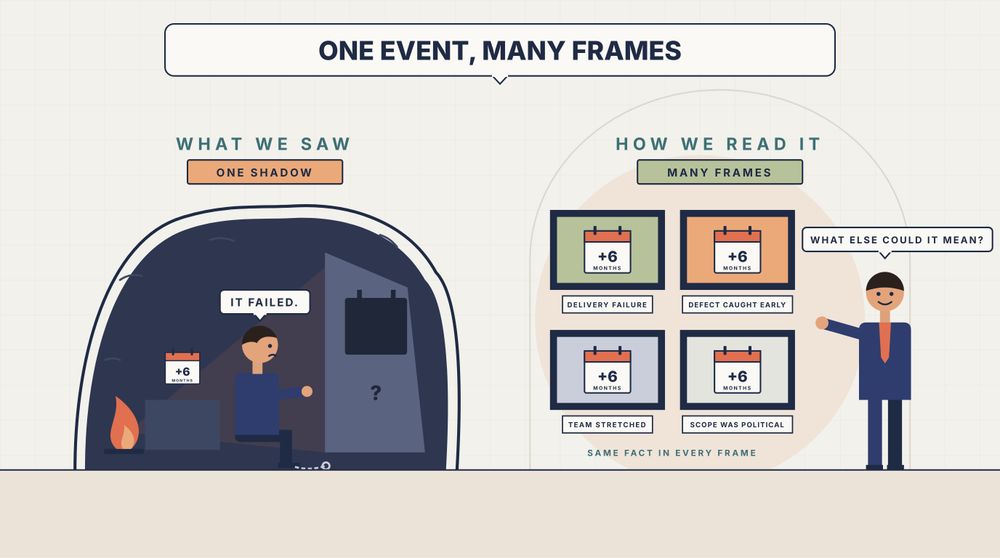
Make judgement visible. For any decision that matters, name who owns it, what the AI contributed and what was checked. Test the big ones against more than one future, not just the one the model drafted.
The ethical bit
Cheap knowledge scales mistakes as easily as insight. When an organisation can produce a thousand recommendations a day, the errors land on customers, staff and communities who never saw the prompt. Being able to answer anything doesn't entitle you to decide everything.
Everyone now has the same access to the same knowledge. What's still yours is the intelligence to know what to ask, what to trust and what to do next.
#AIGovernance #Strategy #WardleyMapping #DecisionMaking #Commoditisation #StrategicForesight #CapabilityBasedPlanning #Governance #BusinessEthics #Leadership