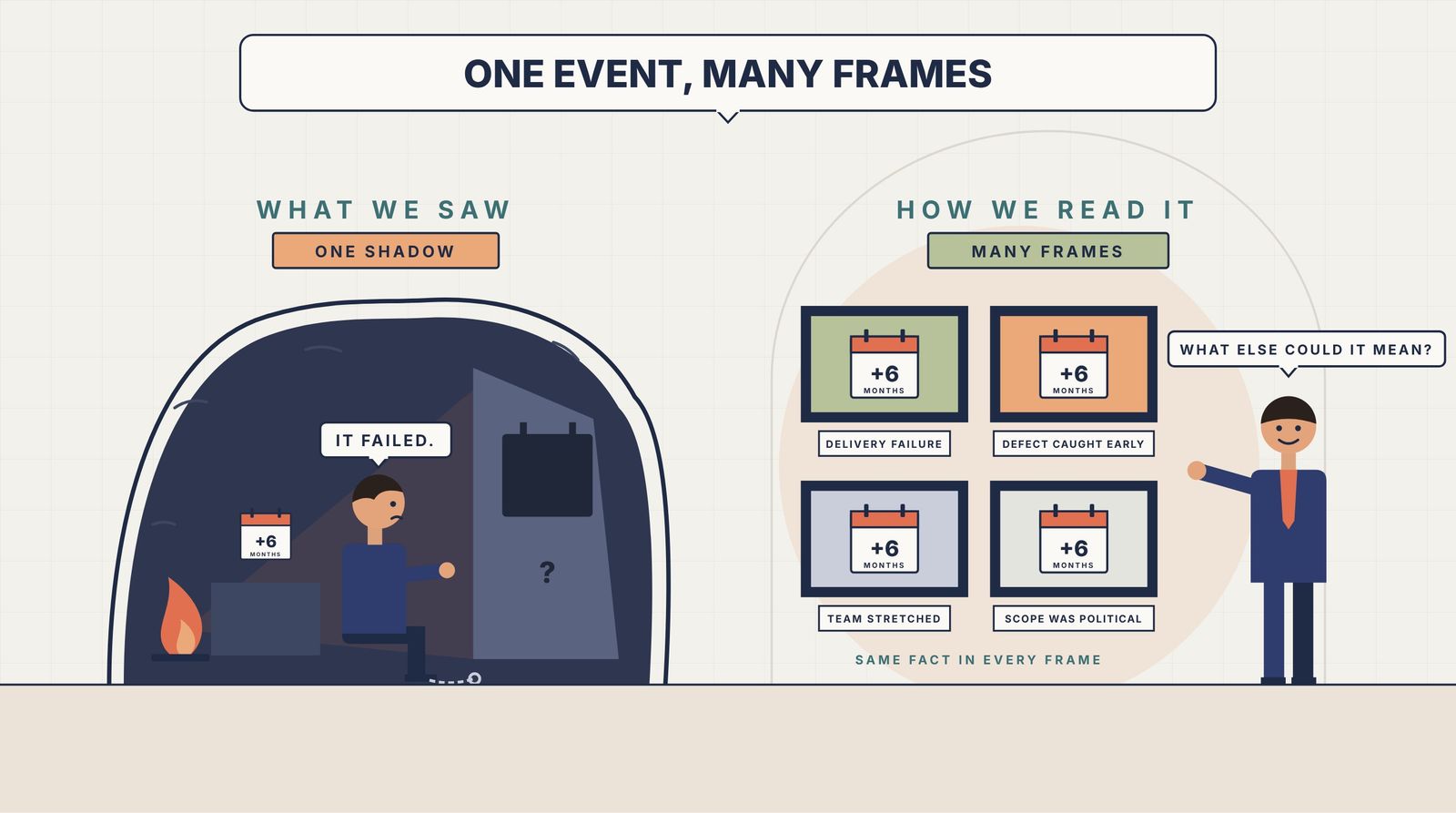
A project lands six months late. In one meeting it's a delivery failure. In the next, someone points out the delay came from stopping to fix a design flaw that would have cost far more after launch. Nothing about those six months has changed. Yet the room now remembers a different event.
That's reframing. It doesn't alter what occurred. It alters what we understand to have occurred, and that understanding drives the next decision. The Greeks worked this out a long time ago.
Epictetus: the event and the opinion
Epictetus, the Stoic teacher who began life as a slave, put it plainly in his Handbook: "Men are disturbed not by the things which happen, but by the opinions about the things." His example was death. If it were terrible in itself, he said, Socrates would have thought so too.
For a leadership team the translation is direct. A lost contract is an event. "We're losing our edge" is an opinion about it. "We bid for the wrong work" is another. Each sends the organisation somewhere different.
This isn't just ancient advice. Albert Ellis, who founded Rational Emotive Behaviour Therapy, credited Epictetus and the Stoics as a primary influence on his idea that our beliefs about events, not the events alone, shape how we respond.
Plato: the shadows on the wall
In Book VII of the Republic, Plato describes prisoners chained in a cave, facing a wall. All they ever see are shadows of objects carried past a fire behind them. To them, the shadows are reality.
Most organisations have a version of that wall. A dashboard, a monthly report, the story told in the first meeting after an incident. People argue about the shadows with real conviction, because it's all they've been shown.
Plato's harder point is about coming back. The freed prisoner returns, struggles to see in the dark, and the others decide the trip outside harmed him. Anyone who brings a new frame into a room settled on the old one should expect a similar welcome.
Protagoras and Socrates: a warning
Reframing carries a risk. Protagoras claimed that man is "the measure of all things." In Plato's Theaetetus, Socrates tests the idea with a simple case: the same wind blows, one person feels cold and the other doesn't. Is the wind cold or not?
Both experiences are real. But Socrates wouldn't accept that every account is therefore equally true. That's the line between reframing and spin. A good reframe holds the facts steady and changes the lens. Spin bends the facts to suit the lens.
The modern evidence
In 1981 Amos Tversky and Daniel Kahneman gave people the same public health problem, framed two ways. Told a programme would save 200 of 600 people, 72 per cent chose it. Told the equivalent programme meant 400 people would die, only 22 per cent did. Identical outcomes, opposite preferences.
If wording alone can do that, the frame your board meets an event through is doing a lot of the deciding.
Putting it to work
Agree the facts before the story. Write down what happened, with dates and numbers, before anyone explains why. A shared baseline gives every frame the same footing.
Try more than one frame on purpose. Bolman and Deal's Reframing Organizations offers four: structural, human resource, political and symbolic. Ask what the event looks like through each.
Test the frame against the future. The story you settle on shapes what you invest in next. Check whether it still holds if things unfold differently.
Protect the person who comes back from outside the cave. The colleague with the unwelcome reframe may be the only one who has seen the objects, not the shadows.
Epictetus wasn't saying events don't matter, he was saying our judgement about them is the part we can work on. The past is fixed, what it means is still open, and that conversation is where the next decision gets made.
#Reframing #Leadership #DecisionMaking #StrategicForesight #SituationalAwareness #Philosophy #Stoicism #BusinessEthics #Governance #CriticalThinking