Centralise or decentralise? Cut costs or invest in growth? Innovate or run a tight ship? Look after the shareholders or look after the people?
Most leadership teams have one of these on the table right now. And most are treating it the same way: pick a side, write the business case, announce the decision. Then, two or three years later, quietly swing back the other way.
If that sounds familiar, you can thank Sir Isaac Newton. Well, sort of.
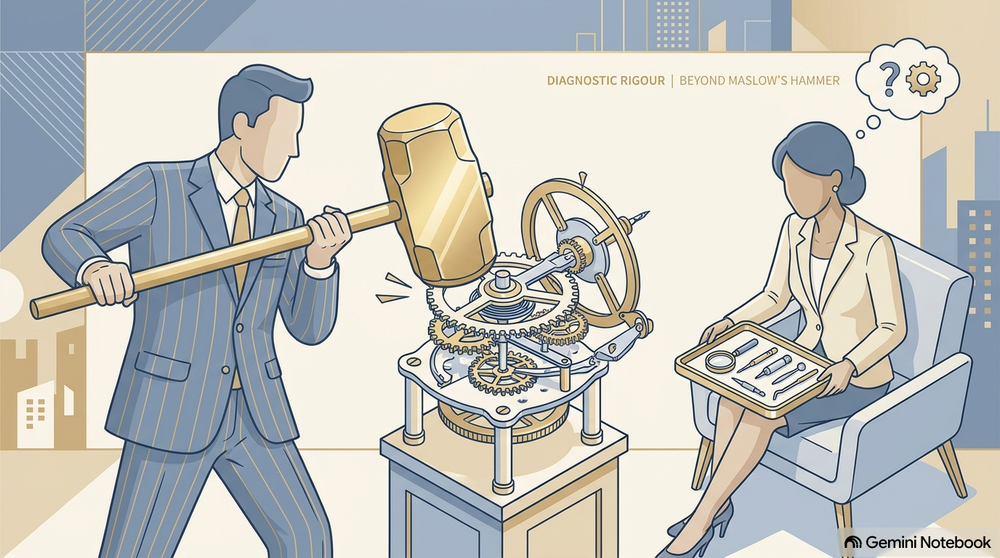
Newton gave us a spectacularly successful way of seeing the world. Break things into parts. Find the cause. Apply the right force and you get a predictable result. Over the following centuries his admirers stretched that thinking well beyond physics, into how we run economies and organisations. The company as a machine. Every problem a broken part. Every broken part has one correct fix.
To be fair to Newton, he didn't invent either/or. The idea that something is either true or false goes back to Aristotle. But the machine mindset gave it muscle. If there's one right answer, anything else must be wrong. So we pick.
The trouble is, many of the problems that end up in the boardroom aren't problems at all. They're dilemmas.
Barry Johnson made the distinction in his 1992 book Polarity Management. A problem has a solution. Fix it and it stays fixed. A polarity is a pair of things you need, which seem to pull against each other, and which never get "solved". Stability and change. Short term and long term. Control and empowerment. Push hard on one and you eventually get the downside of neglecting the other.
That's why the pendulum swings. Centralise for efficiency, and in time the business loses touch with its customers. Decentralise for responsiveness, and in time costs and duplication creep up. Neither decision was wrong. Treating it as a one-off choice was.
Jim Collins and Jerry Porras noticed the same thing in Built to Last back in 1994. They called it the "Tyranny of the OR", the view that can't live with two seemingly contradictory ideas at once. The companies they studied practised the "Genius of the AND": purpose and profit, a stable core and constant change.
So how do you get from OR to AND? Three things help.
Change the question. Instead of "which one?", ask "what do we need from each, and what are the early warning signs we're leaning too far one way?" That small shift turns a fight into a design brief.
Invite the people who live with the consequences. The finance team and the frontline team usually hold opposite ends of the same dilemma. Put them in the same room, not to argue their side, but to imagine together what a good outcome looks like five or ten years out, and in more than one version of the future. People support what they help shape. They also spot the side effects the strategy deck missed.
Give it time. Both/and solutions rarely arrive fully formed. They need a clear direction, a few agreed signals to watch, and permission to adjust as you learn. That isn't indecision. It's governance designed for a dilemma rather than a problem.
None of this means never choosing. Some things really are either/or. You either sign the contract or you don't. The skill is telling the two apart, and not forcing a dilemma into a binary box just because a binary box is easier to put on a slide.
A test for your next leadership meeting: look at the decision you're about to make. Has the organisation made the opposite call before? If so, you may be on a pendulum, not a path.
Two questions I'd love your take on:
- What's the either/or your organisation keeps swinging back and forth on?
- When did bringing the "other side" into the room lead to an answer nobody had thought of?
I help leadership teams test big decisions against more than one future and turn competing priorities into clear, deliberate choices.
#BothAnd #PolarityThinking #DecisionMaking #Leadership #Strategy #SystemsThinking #StrategicForesight #StakeholderEngagement #Governance #BusinessEthics