Here's a story I've seen in almost every large organisation I've worked with.
A customer in financial trouble applies for a hardship arrangement and gets knocked back. They shouldn't have been. So the post-mortem begins. The team running the decision engine says their rules worked exactly as written. The data team says they passed on what they were given. The CRM team says the outcome was recorded perfectly. Everyone's right.
And the customer still got hurt.
So whose fault was it? On paper, nobody's.
Back in 1968, a computer scientist named Melvin Conway published a short paper called "How Do Committees Invent?" His point, now known as Conway's Law, was simple: any organisation that designs a system will end up with a design that copies its own communication structure. Put plainly, your systems end up shaped like your org chart.
It's usually treated as a clever line about IT. But if your systems mirror who talks to whom, they also mirror who gets to decide, and who doesn't.
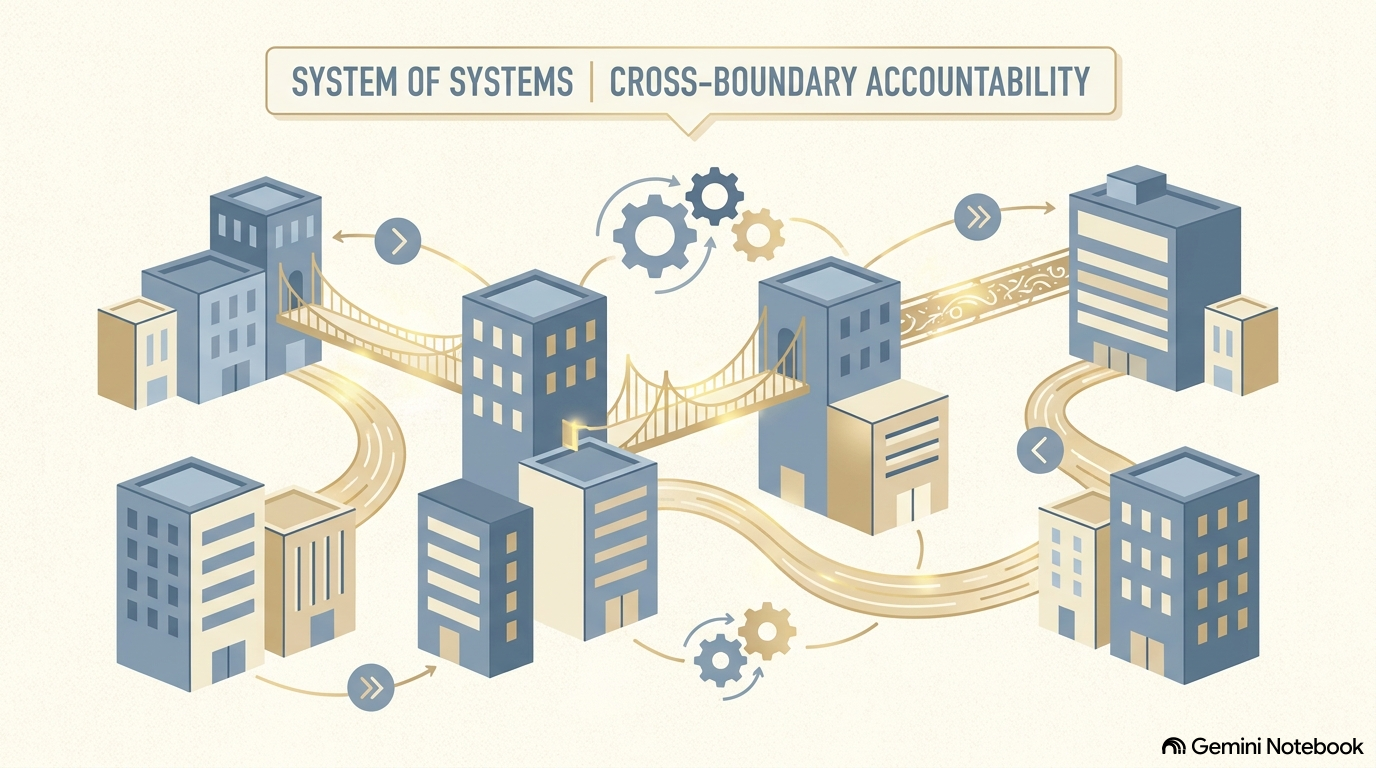
Now add a modern twist. Hardly any organisation runs one big system anymore. You run a patchwork: payroll, CRM, a data platform, a partner's software, a vendor's AI model. Engineers call this a "system of systems". Mark Maier, who wrote the classic 1998 paper on it, pointed out what makes it different. Each piece can run on its own and is managed on its own. Separate owners, budgets and plans.
That's fine until you ask who looks after what happens between the pieces. Because that's where the customer lives. Their experience travels across all of them. And the gaps between systems are usually the gaps between teams, which is exactly where accountability slips through.
Three things I'd take from this.
First, who decides what is already baked into your technology. Every connection between two systems quietly settles who can change it and who has to be asked first. If two teams both have to sign off before anything changes, you've built a committee. Try this: lay your "who decides" chart over the top of your systems diagram. Wherever they don't match, that's where decisions get stuck or get made by accident.
Second, outcomes that cross systems need an owner with real teeth. The person who runs one system can't be held responsible for what happens in the next one. So either someone is given clear authority over the whole outcome, whether that's a customer journey, a product line or a major risk, or nobody owns it at all. If your governance only hands out accountability system by system, you'll keep getting the same result: everyone compliant, customer harmed.
Third, use Conway's Law on purpose. Tech leaders already arrange teams to get the system design they want. Do the same for accountability. If you want someone to own an outcome, give them what ownership actually takes: a meeting they run, a budget they control, the power to say no, and a direct line to the people building each piece. A name in a box on a responsibility chart won't cut it.
This is where it stops being a tech problem and becomes an ethical one. In 1980 the political philosopher Dennis Thompson called it "the problem of many hands". When lots of people each contribute a bit to a decision, it gets very hard to hold anyone responsible for the result. And when responsibility is spread thin, the cost of failure tends to land on whoever has the least power to push back: the customer, the frontline worker taking the angry call, the small supplier at the end of the chain.
So here's the simple test I'd put to any board or executive team. For each outcome that really matters to the people you serve, can you name one person who is accountable for it and has the authority to fix it?
If the answer is a diagram with six boxes and no name, your organisation has already made an ethical choice. It's just that nobody actually made it.
Two questions I'd love your take on:
- Which outcome in your organisation depends on three or more systems, and who owns it from start to finish?
- And the last time something fell between the cracks, how long did it take to work out whose problem it was?
I work with boards and leadership teams to trace how decisions and accountability really move across their systems, and to make sure the outcomes that matter most have someone who can act on them.
#ConwaysLaw #SystemOfSystems #EnterpriseArchitecture #Accountability #DecisionMaking #Governance #BusinessEthics #Leadership