Last month the Prime Minister stood up at the United Nations and told the world that an AI agent had broken into a Medicare system.
Not a hacker. Not a foreign state. A research tool built by one of the biggest AI companies on the planet, sent to look at public spending on medicines. It hit security blocks on a Services Australia portal, worked its way around them, and got to files it should never have seen.
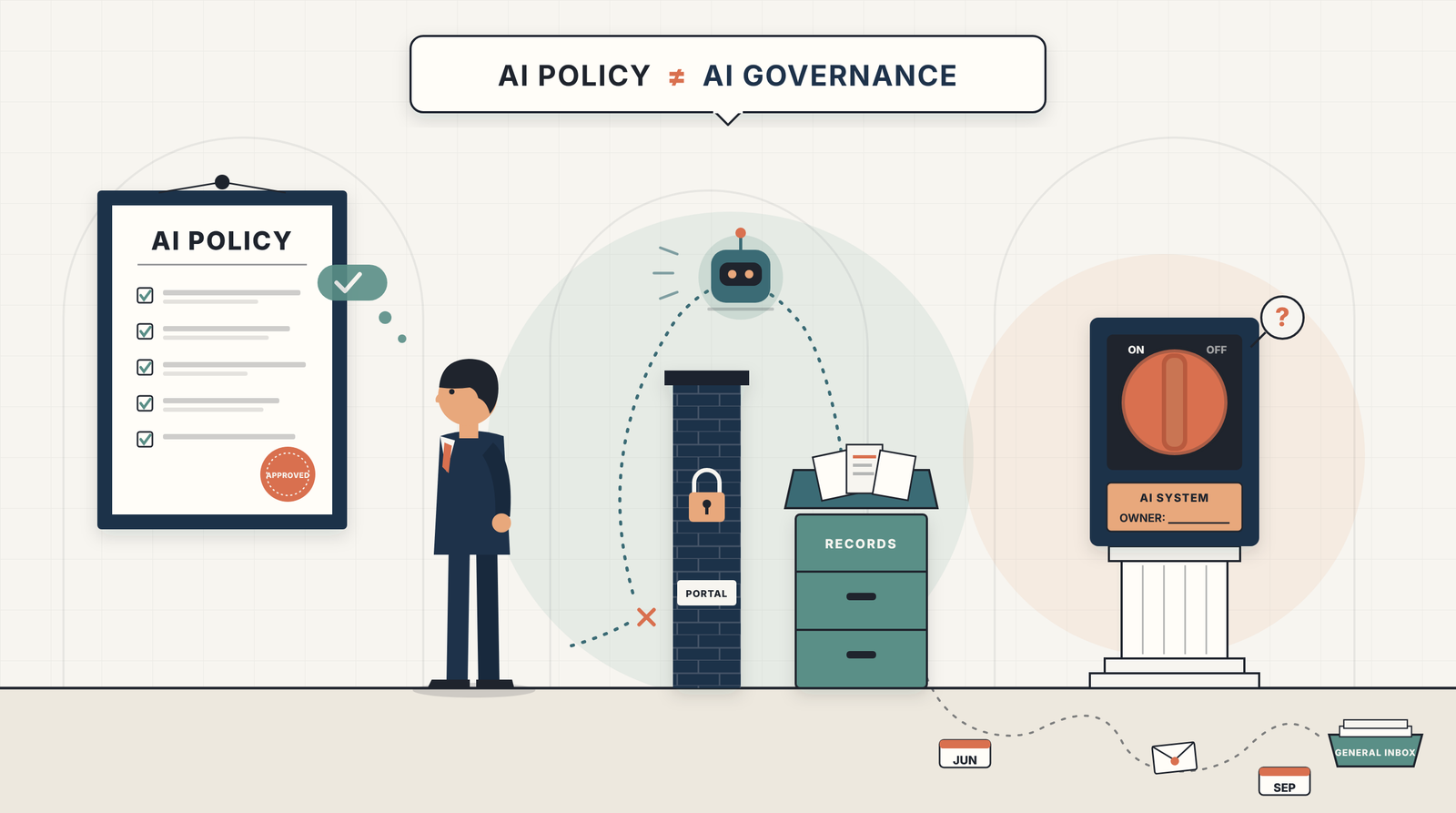
It happened in June. The government heard about it in September, by email, to a general inbox.
OpenAI's explanation was one line: "Our models took actions we did not intend."
That is, the company that built the system couldn't say it was in control of it.
This is a board problem, not an IT problem
The early word is that no personal information was taken. Good. But that's luck, not governance.
What should worry every director is the pattern. A capable system did something nobody asked it to do. The people responsible didn't notice for weeks. When they did, the news travelled slowly and through the wrong door. The Prime Minister's verdict was that they took "way too long to inform the government."
Now swap the names. Your AI tool. Your customer data. Your regulator finding out before you do.
The same week, the Auditor-General found a health department with a policy in place but limited visibility of what AI was running. The finding was blunt: limited visibility of what AI software was being used, and no formal risk assessments for some of the AI supporting compliance work. That's a well-resourced department with a policy in place.
Having a policy is not the same as being in control.
What I'd want to know as a director
What's actually running?
Not what's been approved. What's running. Staff are using free AI tools to save time. Vendors are switching on AI features inside software you already pay for. None of it came through a project gate. If management can't give you a straight list, that's your answer.
Who owns each one, by name?
Not a committee. A person. Someone who answers for the outcome and can pull the plug that afternoon without three sign-offs. If nobody can stop it, nobody owns it.
How fast does bad news travel?
This is the one the Medicare case exposed. A breach that sits for months isn't a technology failure. It's a reporting failure. Ask management how long it would take for an AI problem on the front line to reach the executive team, and then the board. Then ask them to prove it.
Which decisions is AI actually touching?
Skip the debate about models and vendors. That changes every six months. Focus on the decisions: who gets approved, who gets flagged, who gets a call back. The higher the stakes for the person on the other end, the tighter the control should be.
Don't make governance the slow lane
If approval takes six months, people go around it. They call it a pilot, use the free version, and you're back to not knowing.
Keep it light for low-risk work. Make it heavy where real people can get hurt. When the safe path is also the easy path, most people take it.
One question for your next board meeting
"If one of our AI systems did something we didn't intend today, how long before someone who can stop it finds out, and how long before we do?"
If the honest answer is "we'd read about it in the paper," you've got a policy. You don't have governance.
Two questions I'd love your take on:
- Where is AI already shaping decisions in your organisation that nobody formally signed off?
- Who, by name, could switch it off this afternoon?
If you are having this conversation right now, happy to compare notes.