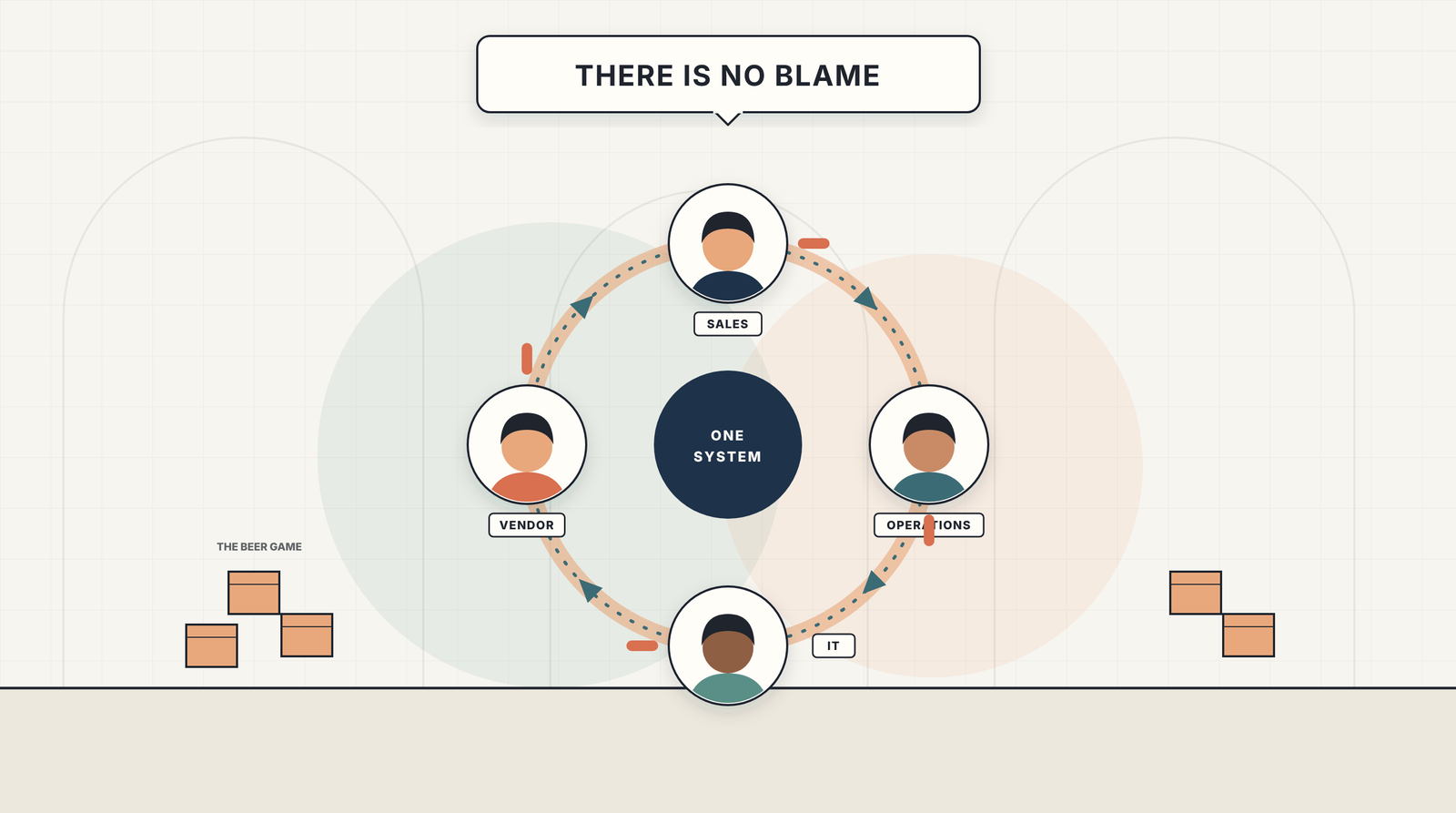
Every organisation has a villain. For sales it's operations. For operations it's IT. For IT it's the vendor. For the board it's often "the market". Ask anyone why a problem won't go away and you'll get a name, usually from another floor.
Peter Senge had a line for this in The Fifth Discipline. The last of his laws of systems is simply: there is no blame. We tend to blame outside circumstances, he wrote, but systems thinking shows "there is no separate 'other'; that you and the someone else are part of a single system."
He took it a step further. The cure lies in the relationships with the very people we typically blame for the problems we are trying to solve.
That's uncomfortable for executives. It means the fix is probably sitting with the team you've stopped inviting to meetings.
Senge's favourite demonstration is the Beer Game, developed at MIT in the 1960s. Players take the roles of retailer, wholesaler, distributor and brewery. Each makes sensible decisions using only what they can see. A small bump in customer demand turns into wild swings of shortages and overstock up the chain. Afterwards almost every player blames someone else: the customers, the supplier, the person next to them. Swap the players and you get the same result. The structure did it.
Now think of your organisation as a complex adaptive system. That's the term for systems made of many parts that each react to one another: markets, ecosystems and, yes, companies. Nobody controls the whole. Behaviour emerges from how the parts respond to each other. Finance adapts to your sales targets. Your vendor adapts to your contract. Customers adapt to your call-centre scripts. Then you adapt to them.
In that kind of system, "them" is just a part of "us" you haven't looked at closely.
Blame feels like accountability, but it works against it. When people expect blame, they hide bad news, protect their patch and aim to be defensible rather than right. The information that would fix the problem stops flowing, and it stops at exactly the boundary where the problem lives.
In my last piece I wrote that no blame doesn't mean no ownership. Here's the flip side: ownership without relationship doesn't work either. You can put one name on an outcome that crosses three teams, but if that person is at war with two of them, nothing changes.
Three things any leadership team can do.
Name your "other". At your next executive meeting, ask: who do we blame most often? That team, vendor or regulator is probably the most important relationship you're not investing in.
Map the loop, not the culprit. When something goes wrong, draw how each party's reasonable decisions fed the next one. Keep it to a page. It's much harder to point fingers at a diagram you're all standing in.
Put the blamed in the room. Bring the supplier into the design session. Bring IT into the product decision before it's made, not after. Share a few measures across the boundary so both sides feel the same pain at the same time.
There's an ethical side too. Blame travels downhill. It lands on whoever has the least power to push back: the frontline worker, the junior analyst, the small supplier, sometimes the customer ("they should have read the terms"). A blame culture isn't just ineffective. It's unfair, because it hands out responsibility by position rather than by cause.
A simple test: think of the problem your organisation has "solved" three times. Who did you blame each time? And have you ever sat down with them to work out what the system is doing to both of you?
Two questions I'd love your take on:
- Who is the "other" in your organisation, the team or partner everyone quietly blames?
- What changed the last time you worked on the relationship instead of the rule?
I help boards and leadership teams see the whole system they're part of, including the parts they usually blame, so problems get fixed where they actually start.