Last week Australia's biggest float since Telstra fell over. Firmus, the Nvidia-backed "AI factory" builder, opened its books at A$11 a share, a value of around A$44 billion. Within days there was talk of a smaller deal at a lower price. Then it withdrew its listing altogether.
The post-mortem has been loud. Co-CEO Oliver Curtis said Australia had a "mantra of disbelief". Backer James Packer said Australia tears down aggressive entrepreneurs. Local fund managers replied that investors had simply done their sums.
I'm less interested in who won that argument than in what it tells boards about moving fast with other people's money, power and water.
Start with the story the market was asked to buy. Firmus was valued at A$1.85 billion in September 2025. Thirteen months later it asked the public for more than twenty times that. One critique put its FY2026 operating revenue at around US$50 million, against roughly US$30 billion of debt. Crikey asked why local investors were told the float was effectively oversubscribed when, 48 hours later, a big discount was on the table. That same week, Firmus pulled out of a federal parliamentary inquiry into AI.
Nobody has suggested any of this was illegal. But "legal" and "fair to the retail investor reading the headlines" are different tests.
Then there's the dependency. Nvidia is a Firmus shareholder, its main supplier and a source of financing support. That's credibility and concentration in the same package. When one partner is your investor, your supplier and your backstop, it isn't one risk on the register. It's most of the register.
Senge's last law is "there is no blame." Blaming "risk-averse Australia" is the classic move he warned about: point at the other, and miss the system you're both in. The market didn't fail. It did its job.
The harder question sits in Tasmania.
Firmus has asked Hydro Tasmania for 444 megawatts across its three Tasmanian sites. That's more than the Bell Bay aluminium smelter, the state's biggest power user. Its website accidentally revealed a plan to cool a data centre with water from an irrigation scheme built for farmers. It got the number of diesel generators wrong in one application. A council has asked it to stop work while it checks whether clearing exceeded its forest practices plan. The state parliament has opened an inquiry.
To be fair, Firmus says it will support roughly two megawatts of new renewable generation for every one it contracts, uses less cooling water than traditional designs, and promises hundreds of construction jobs. Those are real commitments.
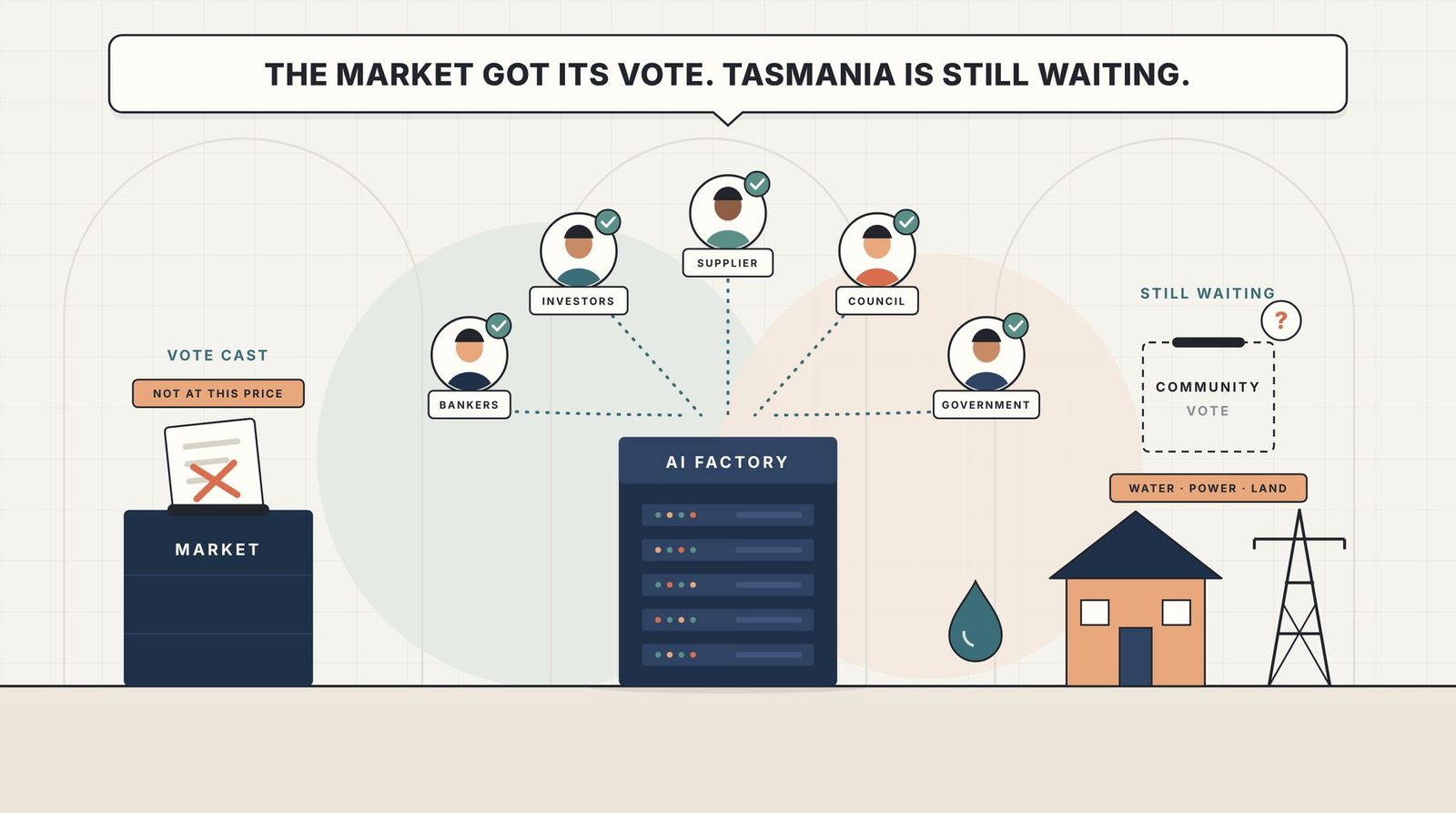
But look at who decided what. Bankers priced it. Nvidia financed it. Investors backed it. Councils approved it. The government welcomed it. Each did their part, and each can explain it. In 1980 the philosopher Dennis Thompson called this the problem of many hands: when everyone contributes a bit, it becomes very hard to say who is responsible for the result.
The float could be pulled in a week. The 288-megawatt data centre approved at Bell Bay can't. If the numbers don't hold, the cost won't land on the people who priced the deal. It lands on the farmer's water allocation, the household power bill and the town that built its plans around those jobs.
Three things I'd take into any boardroom.
Test the story against more than one future. What happens if compute gets cheaper faster than the debt gets repaid, or a key partner's priorities shift? A plan that only works in one future isn't a strategy. It's a bet.
Make your dependencies visible before the market does it for you. If the whole case rests on one partner, say so, and show what happens without them.
Put a name on the outcomes beyond your fence line. Energy, water and community trust aren't externalities. They're part of the deal. Someone at the table should own them, with the authority to slow things down.
One question I'd love your take on: when your growth depends on someone else's water, power or patience, who in the room speaks for them?
The market got its vote and said "not at this price". Tasmania's farmers and households haven't had theirs, and the construction crews aren't waiting.