Remember March 2020? Supermarkets rationing toilet paper. Hospitals scrambling for masks and gowns. Businesses discovering that a part they'd bought for years came from one factory, in one country, through one port. For a lot of Australian boards, COVID was the moment the supply chain stopped being an operational detail and became a board question.
It wasn't really a forecasting failure. Pandemics had sat on risk registers for years. The harder problem was that the possibility never made it into where capital went, how much stock was held, or who the business depended on.
When the Productivity Commission looked at Australia's supply chains in 2021, its findings were calmer than the headlines. Most essential supply chains had held up. Genuinely vulnerable imports were few, personal protective equipment and certain chemicals among them. It also said firms are generally best placed to manage their own supply chain risks, through stockpiling, contracts and diversification. In other words, it's a board job.
The shocks haven't stopped since. A 10 per cent US tariff on Australian goods from April 2025. Conflict in the Middle East. In the AICD's latest Director Sentiment Index, almost 90 per cent of directors expect business costs to rise, with material impacts on trade flows and supply chains. It's no longer a briefing item. It's a balance sheet item.
From offsite to operating rhythm
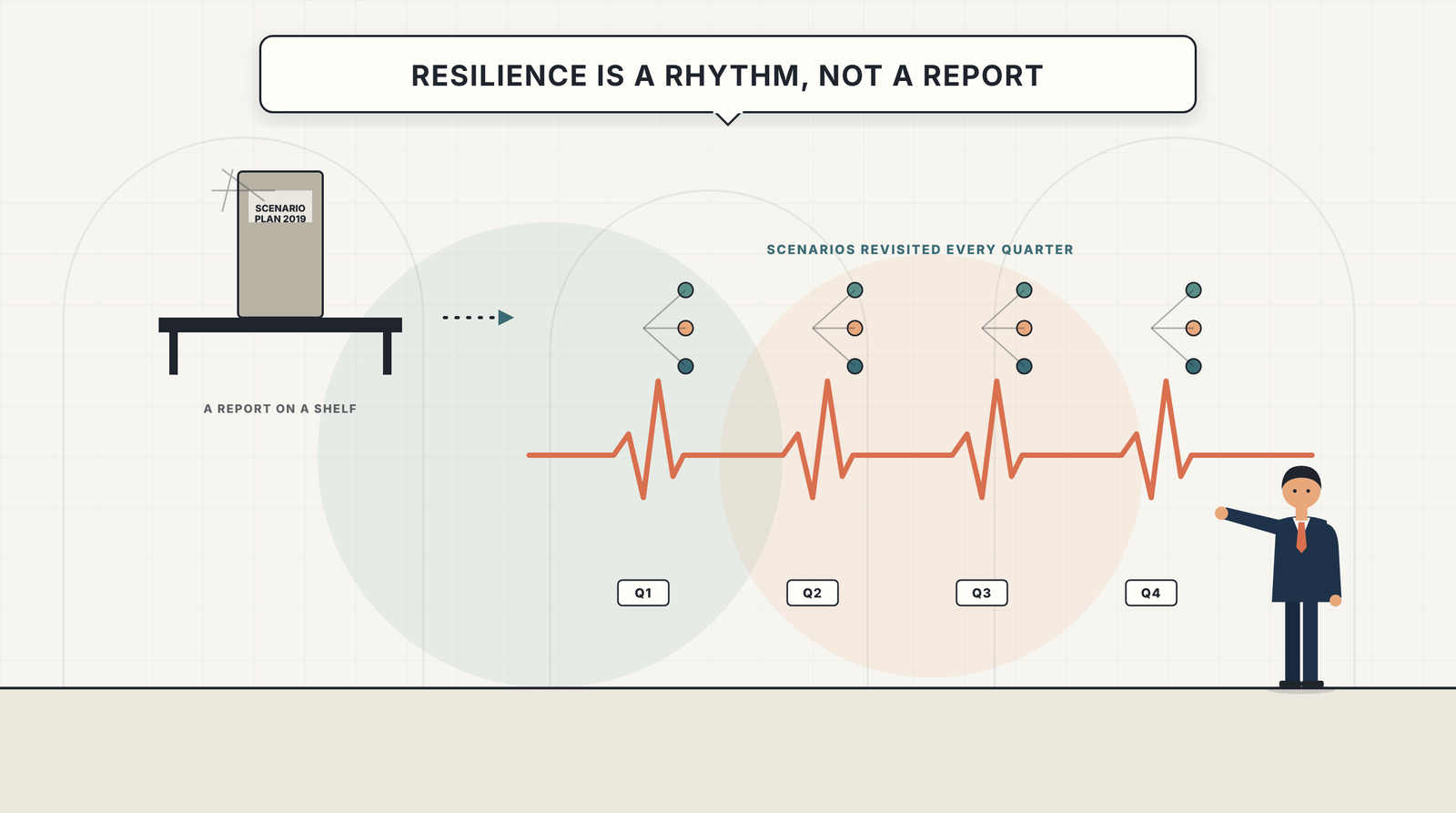
For a long time, scenario planning lived at the annual strategy day. A facilitator, four quadrants, some colourful names for each future, then everyone went back to the single-point budget. The scenarios went in a drawer.
That doesn't survive assumptions that move between board meetings. What's changing in the better boardrooms is the rhythm. Scenarios aren't a once-a-year deliverable. They're a standing lens every major decision passes through.
In practice, that looks like this.
A small set of live scenarios, refreshed on a cycle. Three or four plausible futures, not a hundred. Revisited quarterly, with management saying what's moved.
Capital tested against more than one future. Before a major investment is approved, the question isn't just "what's the return?" It's "what happens to this in each scenario?" An investment that only works in the base case is a bet, and the board should know it's placing one.
Dependencies made visible. You can't diversify a supply chain you can't see. Most organisations know their first-tier suppliers. Far fewer know who supplies them, or how many of those paths run through the same port, country or chokepoint.
Triggers agreed in advance. What signal would tell us we're heading into scenario B? Who decides what happens next? Settling that calmly in February is far easier than in a panic in August.
A roadmap, not a wish list. A second supplier, a new market or extra inventory all cost money. Resilience has to be sequenced and paid for like any other capability, with clear points to check it's still worth it.
It was never about prediction
None of this is new. Shell's planners, Pierre Wack among them, started building scenarios in the late 1960s, and that work helped the company prepare for the 1973 oil shock. But the point was never to guess right. It was to shift how managers saw the world, so when it changed, they recognised it sooner and already had a sense of what to do.
That's the part boards most often miss. A scenario that doesn't move anyone's thinking is just a nice document. The value is in the argument it forces: the CFO and the head of operations disagreeing out loud about which future worries them more, and the board deciding what it's prepared to pay to be ready for both.
The real shift
Resilience used to mean having a plan for when things go wrong. Now it means being organised to change direction without starting from scratch. That's less about any single scenario and more about the habit: looking ahead on a schedule, knowing where you stand, making explicit choices, and building only what those choices need.
Nobody wants to relearn March 2020. The boards that took the lesson seriously are making sure the next shock finds them already rehearsed.
#StrategicForesight #ScenarioPlanning #Resilience #SupplyChainResilience #BoardGovernance #Governance #Strategy #DecisionMaking #Leadership