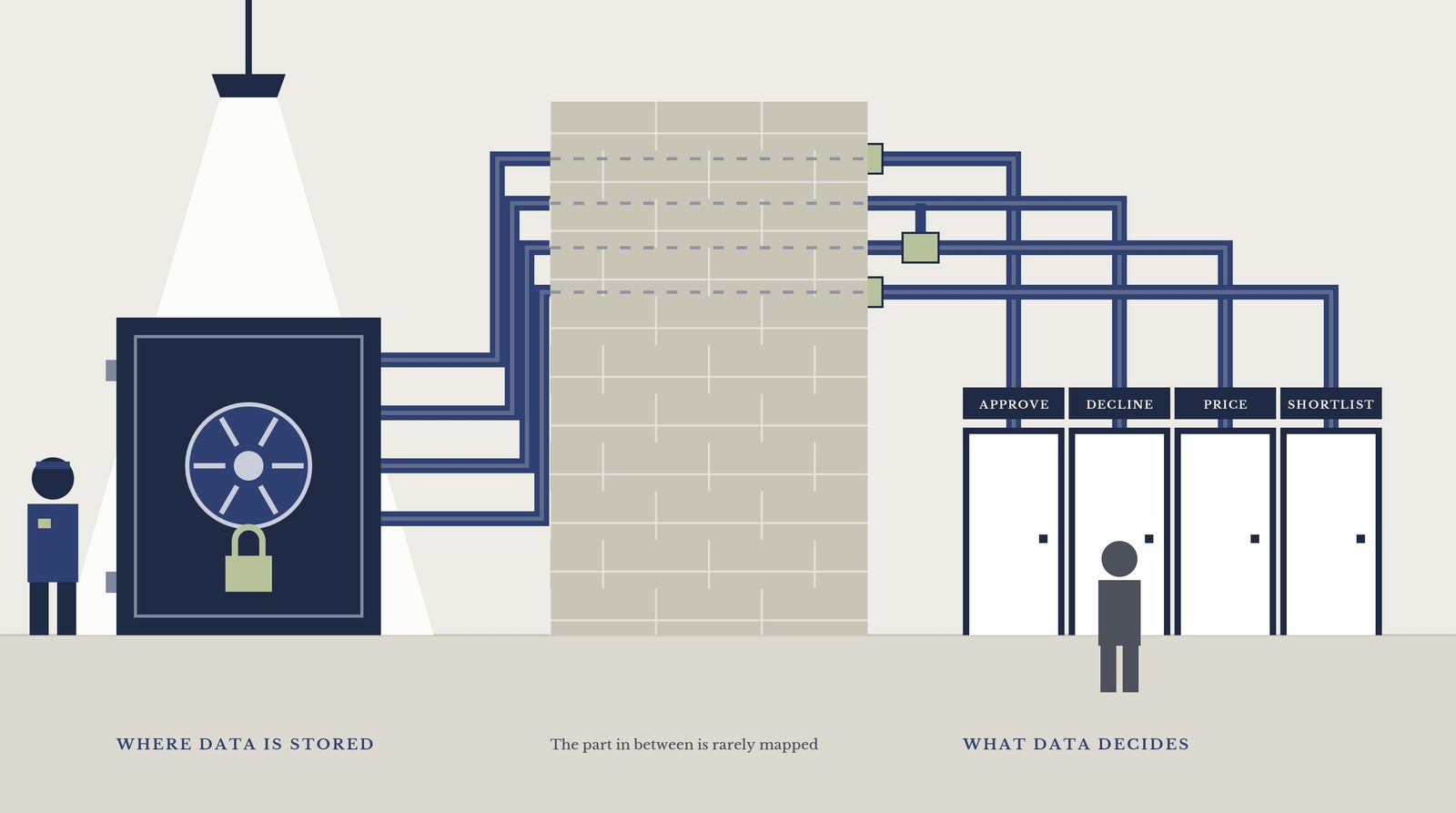
Ask about data governance and you'll hear about the vault. Where data is stored. Who can reach it. What happens after a breach.
All of that matters. But from 10 December, Australian privacy law adds a different question. Not where your data sits, but what it decides. Answering it is an enterprise architecture job.
What actually changes
New Australian Privacy Principles 1.7 to 1.9, added by the Privacy and Other Legislation Amendment Act 2024, start that day. Organisations covered by the Privacy Act must describe in their privacy policy the kinds of decisions computer programs make, or substantially and directly shape, where those decisions could significantly affect someone's rights or interests. They must also describe the kinds of personal information those programs use.
The Office of the Australian Information Commissioner (OAIC) released guidance on 30 September that casts a wide net. "Computer program" covers AI and generative AI, but also rule-based processes and ordinary software. One OAIC example is a spreadsheet formula that ranks aged care clients, which staff use to decide who gets a call.
Human review doesn't automatically take a decision out of scope, and the obligation generally stays with you even when a vendor built the program. You describe categories, not individual cases, and you don't have to reveal how the logic works.
The answer runs across your architecture
Categories sound simple. To write them honestly, you need to trace each type of decision back to the data feeding it. That line crosses every layer of the enterprise.
The decision lives in the business architecture: which capability makes it, in which process, owned by whom. The program lives in the application architecture: the in-house model, the vendor platform, the unregistered spreadsheet. The personal information lives in the data architecture: where it came from and why it was collected.
Data governance usually owns only the last layer. Catalogues list tables. Access controls list people. Very few organisations hold the joins between the three, and those joins sit behind every category the law now asks you to name.
AI makes the joins longer. A churn score feeds a pricing rule. The OAIC's 2024 AI guidance says information a model infers about an identifiable person is personal information, even when wrong. That score is data you own, sitting between systems nobody mapped together.
APP 10 already requires personal information you use to be accurate, up to date, complete and relevant. Once a decision is automated, a stale address isn't a data quality ticket. It's the reason someone was declined.
Why architecture, not another register
I've described enterprise architecture before as scaffolding: the decision rights, interfaces and models that hold a strategy up. December tests that idea. A privacy policy is a public claim about how your organisation works. Architecture is how you know whether the claim is true.
Treat this as a compliance list and your register drifts the moment systems change. Link decisions, applications and data in the architecture you maintain, and the picture updates through change and procurement processes you already run.
What to do in the next seven weeks, and after
Start from the decision, then walk the layers. For each type of decision that affects customers, staff or members, record the capability and owner, the programs involved and the data they use. It gives leadership a shared picture of where they stand.
Make derived data visible. Give scores and inferences owners, quality rules and retention settings, like the raw data they came from.
Add a decision check to architecture review. Any new system, model or vendor change touching a significant decision is assessed for disclosure impact before go-live.
Ask vendors for an inputs list. Which personal information their tool uses, and how they'll flag changes. Write it into the contract at renewal.
Sequence the fix. Start where stakes are highest: credit, pricing, hiring, essential services.
In 2023 the government also agreed people should be able to ask how a significant automated decision about them was made. It isn't law yet. Architecture that already joins decisions to data won't need rebuilding when it is.
On 11 December your privacy policy will describe, in public, how data shapes decisions about people. Whether that description is true depends on whether your architecture can see past the vault.
#DataGovernance #EnterpriseArchitecture #AIGovernance #Privacy #AutomatedDecisionMaking #ResponsibleAI #Governance #Accountability #DecisionMaking #Leadership