In the modern discourse on team building, we often hear that "Diversity Trumps Ability." As a researcher in Ethical Decision-Making, I agree, but with a critical, often ignored caveat: Diversity only scales when it is built upon a foundation of core competency.
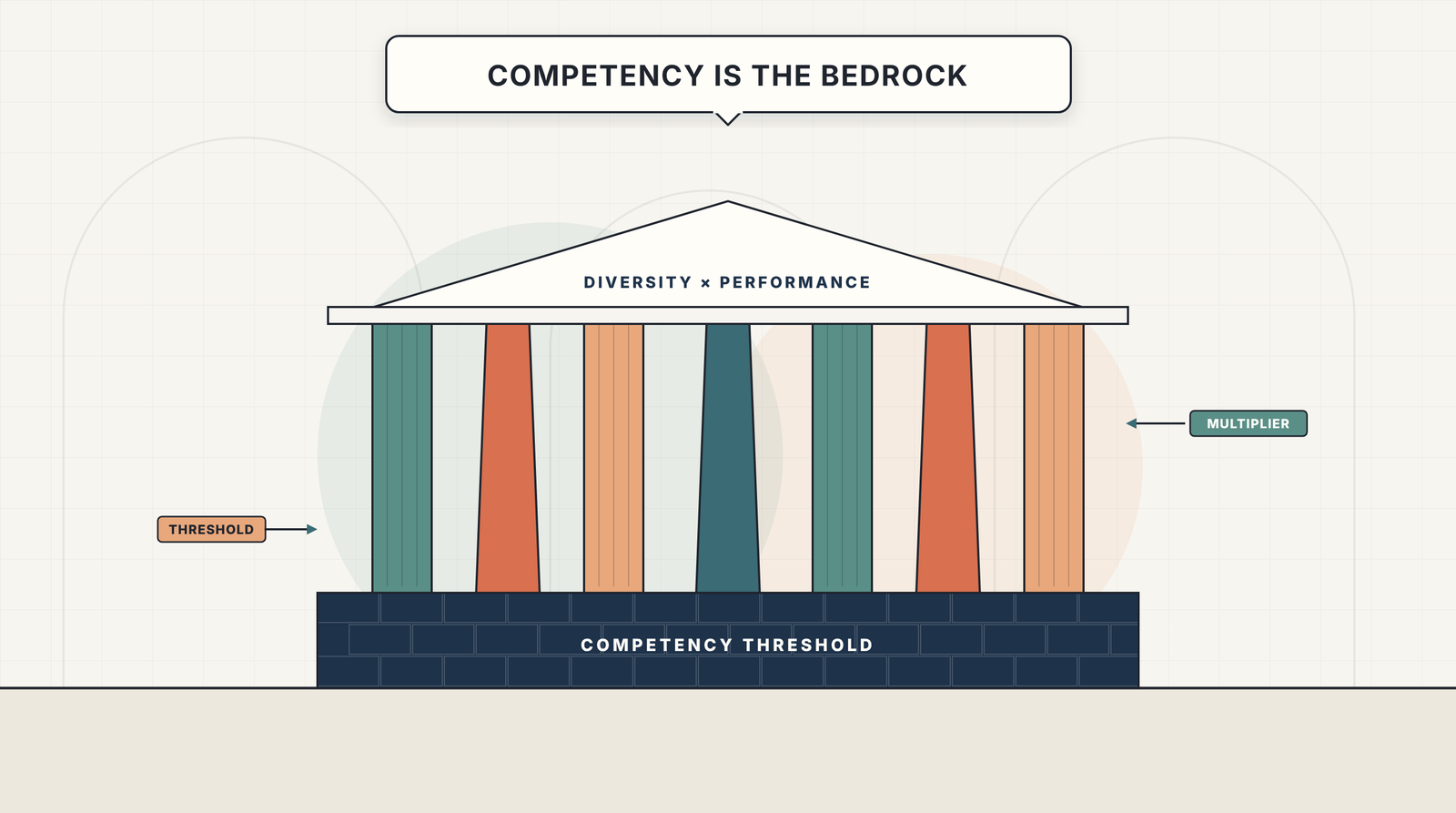
To build a high-performing team, we must stop viewing "Competency" and "Diversity" as opposing forces. Instead, we must recognise that Competency is the threshold, and Diversity is the multiplier.
The "Threshold Competency" Requirement
In any complex system, whether it’s a surgical team or a strategy board, there is a minimum level of technical and cognitive skill required to participate. Academics refer to this as Relevant Task Expertise.
If a team member does not meet the "Competency Threshold," they cannot contribute their unique perspective effectively. Instead of adding a new "heuristic" (problem-solving tool) to the group, they create Information Asymmetry and slow down the Behavioural Integration of the team.
The Architect’s Rule: You cannot aggregate "zeros." Diversity multiplied by zero competency still equals zero output.
Avoiding "Social Loafing" and Resentment
When diversity is prioritised at the expense of baseline competency, organisations risk creating Fault lines.
If high-performing members feel that the "Competency Gap" is too wide, it leads to:
- Affective Volatility: Frustration and emotional outbursts that derail logical discourse.
- Destructive Discord: A breakdown in trust where the "Expert" subgroup stops sharing information with the "Diverse" subgroup.
- The Erosion of Meritocracy: Once the belief in a merit-based "Foundational Competency" is lost, the Organisational Climate turns from collaborative to political.
Diversity as the "Optimisation Layer"
Once the Competency Threshold is met across the board, diversity becomes your greatest competitive advantage. This is where the magic happens.
If you have five "Competent" engineers who all think the same way, you have redundancy. But if you have five "Competent" individuals, one engineer, one psychologist, one historian, one financier, and one operator, you have a Cognitive Powerhouse.
Their shared competency allows them to speak a common professional language, while their diverse backgrounds allow them to see different risks and opportunities. This is the path to Epistemic Accuracy.
How to Apply This to Your Strategy
As leaders and Organisational Architects, our job is to:
- Define the Floor: Clearly articulate the "Non-Negotiable Competencies" required for the role.
- Standardise the Assessment: Use objective metrics to ensure every candidate clears that floor.
- Optimise for Divergence: Once the "Competency Filter" is passed, choose the candidate who adds the most Cognitive Variety to the existing team.
The Bottom Line
Diversity is not a substitute for ability; it is the evolution of ability. By ensuring we have "Competency First," we protect the integrity of our diverse hires and ensure they have the structural support to thrive.