Every executive knows this. You fix a problem, the numbers improve, and six months later something breaks in someone else's patch.
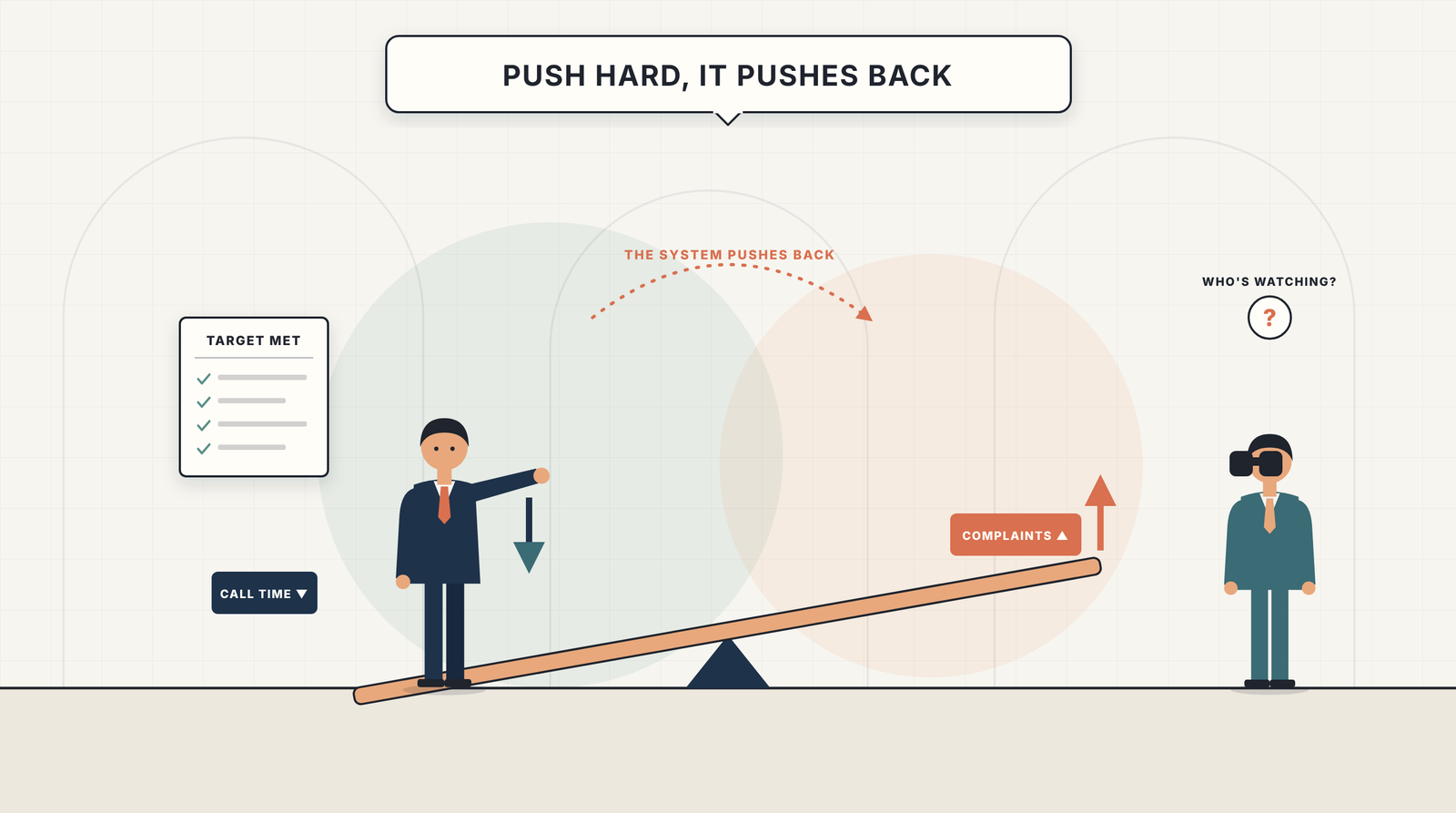
Peter Senge named it in 1990 in The Fifth Discipline: "the harder you push, the harder the system pushes back." He called it compensating feedback. You make a well-meant change, and the organisation quietly responds in ways that cancel out the benefit.
MIT's Jay Forrester said something similar in 1971. Social systems like organisations, he wrote, are "inherently insensitive to most policy changes that people choose." Most levers we pull don't do what we think, and when we find the one that matters, our gut often pushes it the wrong way.
Two made-up but familiar examples.
The contact centre is told to cut call times. Call times drop. But customers whose problem didn't get solved ring back, so repeat calls and complaints go up. Target met, customer worse off.
After an incident, a new sign-off step is added. People start working around it. A shadow process appears. The dashboard shows full compliance while the actual risk moves somewhere nobody's looking.
Nobody did anything wrong. That's the point.
Most organisations today aren't one system. They're a patchwork: finance, CRM, a data platform, outsourced partners, a vendor's AI tool. In 1998 the systems engineer Mark Maier described these "systems of systems". Each part runs and is managed independently, with its own owner, budget and targets.
So when one area pushes, the others adjust to protect their own numbers. The push-back rarely comes back to the person who pushed. It turns up in a neighbouring team, months later, looking like their problem. Senge put it this way: cause and effect are not closely related in time and space.
This is where it becomes an accountability issue. The person who made the call sees their numbers go green. Someone else inherits the cost and is held accountable for a problem they didn't cause and can't fix. Your org chart decides who gets to see the consequences, and in most org charts the person who made the decision never does.
Senge's last rule was "there is no blame." That's not a free pass. It means the problem usually sits in how things are set up, not in any one person. But no blame doesn't mean no ownership. Someone still has to own what happens next.
Three things any leadership team can do.
Ask "then what?" before you decide. Who will react to this change, and how? Think a step or two past your own area and write it down, so you can check later.
Make sure the bad news finds its way home. Whoever makes a decision should see what it did downstream. Share a few measures across team boundaries, and review big decisions when their effects are likely to show up, not just at the next quarterly.
Put a name on the outcomes that cross teams. If a result depends on several areas, one person should own it end to end. And they need the authority to act: a seat at the table, a budget, and the standing to ask other teams to change.
There's an ethical side too. Push-back doesn't just cancel out benefits. It shifts costs, and those costs usually land on people with the least say: the customer stuck on hold, the frontline worker doing the workaround, the small supplier squeezed to hit someone else's target. If you can't see the push-back, you can't see who's paying for it.
A simple test: for your last big decision, who was watching how the organisation reacted, and when did they last report back? If the answer is nobody, the organisation is still reacting. You just aren't hearing about it.
Two questions I'd love your take on:
- Where have you seen a well-meant change backfire?
- In your organisation, does the person who makes a decision ever see what it costs further down the line?
I help boards and leadership teams see how decisions ripple through their organisation, so consequences reach people who can act.