Philosophers have been arguing about this for millennia. Here’s why that argument matters for how you show up at work — and a practical framework for finding your own answer.
Last year, I watched a colleague agonise for weeks over whether to raise a concern about a colleague interaction that didn’t feel quite right. Nothing illegal. Nothing obviously harmful. Just something. A quiet discomfort that wouldn’t leave.
She eventually raised it. Some people thought she was overthinking it. Others said she was brave. The outcome was ambiguous. And she still isn’t sure she did the right thing.
That ambiguity isn’t a failure of character. It’s the nature of ethics. And it’s something business culture is surprisingly bad at acknowledging.
What is an ethical decision, exactly?
At its most basic, an ethical decision is one made by weighing what is right, not just what is legal, profitable, or convenient. But the moment you ask “what is right?”, you’ve stepped into one of the oldest, most contested debates in human thought.
There is no settled answer. And the academics who study this professionally disagree, sharply, on some very fundamental questions.
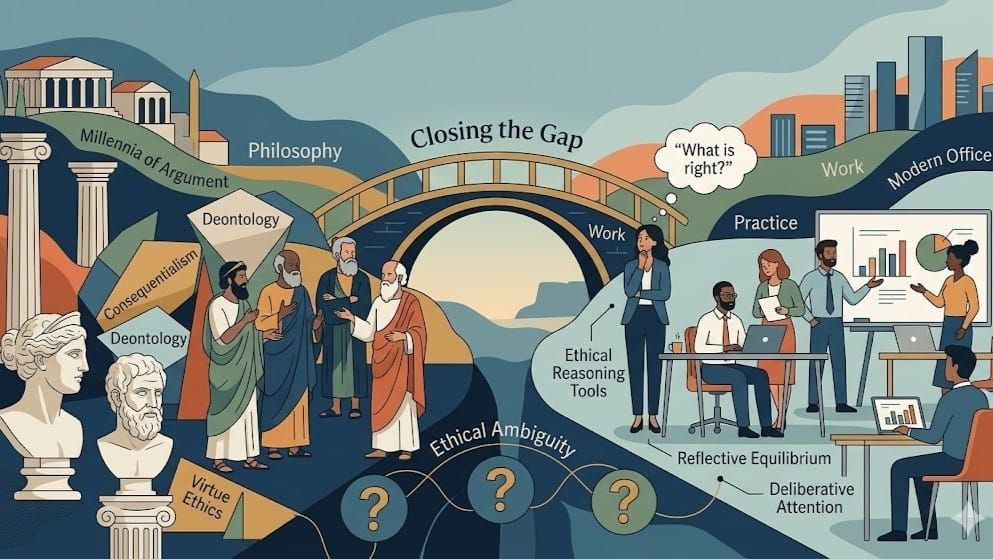
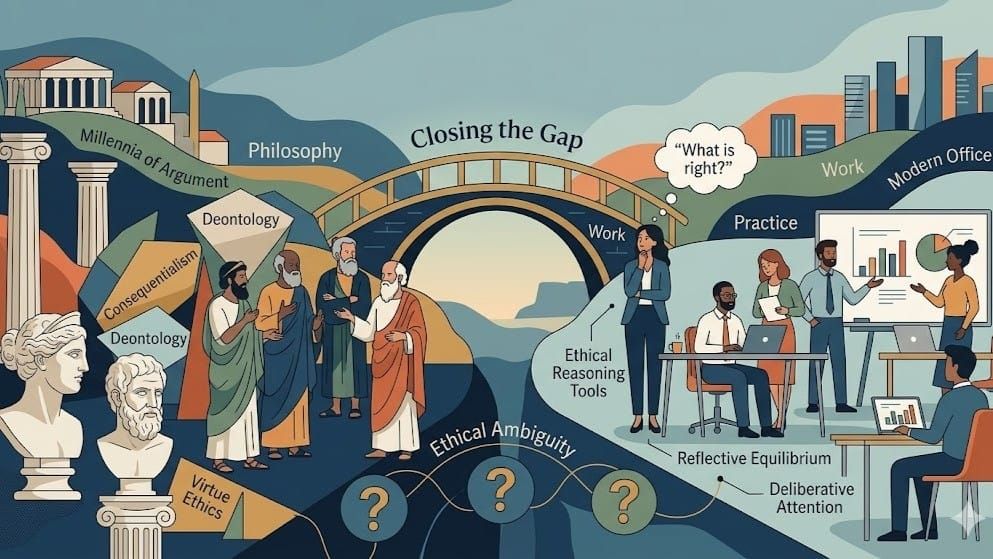
Consequentialism
“A decision is ethical if it produces the best outcomes for the greatest number.”
But who decides what “best” means? And what if the right outcome requires treating individuals unjustly?
Deontology
“Some actions are inherently right or wrong, regardless of their outcomes.”
But rigid rules can lead to morally absurd results when real-world situations defy clean categories.
Virtue ethics
“Focus on being a good person. The right actions flow from good character.”
But “good character” is culturally shaped, and who sets the standard for what virtue looks like?
These aren’t just ivory-tower debates. They map directly onto real tensions in business: does a company owe loyalty to shareholders above all else (a consequentialist framing), or are there things it simply must not do regardless of financial gain (a deontological constraint)? Should leaders focus on building ethical cultures (virtue), or on enforcing ethical rules (deontology)?
“The problem isn’t that we lack ethical frameworks. It’s that we have too many, and no agreed way to choose between them.”
The dispute that never gets resolved
Moral philosophers have a particular area of deep, ongoing disagreement: the question of moral realism. Are ethical truths objective facts about the world, things that are true whether or not anyone believes them? Or are they constructed through culture, consensus, or individual reasoning?
Moral realists argue yes, there are objective ethical truths, we may not always know them, but they exist. Anti-realists say ethics is irreducibly social, contextual, and constructed. There is no ethical “view from nowhere”.
This matters in practice. If ethics is objective, the task is to get better at discovering it. If it’s constructed, the task is to build better processes for deliberating about it together. Both paths lead somewhere useful, but they’re very different journeys.
Applied ethicists add a further layer of dispute: even if we agree on a framework, we often disagree on how to apply it. What counts as harm? Whose interests count? What obligations does power create? These aren’t questions with clean answers, and researchers working in business ethics, bioethics, and political philosophy often reach wildly different conclusions using the same foundational tools.
The gap that needs to be closed
Academic ethics is rich with nuance and rigour. Everyday ethics, in organisations, in leadership, in the small decisions of working life, is almost entirely disconnected from it.
That gap is the real problem. Most professionals making consequential decisions have had no training in ethical reasoning. Ethics in workplaces tends to mean compliance: don’t break the law, don’t expose the company to liability, follow the code of conduct. These are important, but they are the floor, not the ceiling.
The academic world has spent decades developing sophisticated tools for ethical reasoning, stakeholder analysis, reflective equilibrium, ethical stress-testing, and almost none of it reaches the people making decisions about hiring, procurement, product development, or client relationships.
Closing this gap requires two things: translating ethical scholarship into usable frameworks for practitioners, and creating organisational cultures where ethical deliberation is valued, not just ethical compliance.
So how do I know if I’m being ethical?
Here’s the honest answer: you can’t always know with certainty. But uncertainty doesn’t mean helplessness. There are questions you can ask, and the quality of your ethical reasoning lives in the asking, not just in the conclusion.
A practical self-assessment
- 01 — The transparency test: Would I be comfortable if everyone affected by this decision could see exactly how I made it?
- 02 — The reversal test: If I were on the receiving end of this decision, would I consider it fair, even if I didn’t benefit from it?
- 03 — The stakeholder scan: Who else is affected by this that I haven’t yet considered? What do they need?
- 04 — The long game: Does this decision hold up over time, or does it create harm that surfaces later?
- 05 — The discomfort check: Is there something about this decision I’ve been avoiding looking at directly?
- 06 — The wisdom test: What would someone I deeply respect, for their integrity, not just their success, do here?
None of these tests gives you a definitive answer. What they do is slow you down, which is often the most ethical thing you can do. Most ethical failures aren’t the result of people choosing to do wrong. They’re the result of people not pausing long enough to realise they had a choice.
The colleague I mentioned at the start? I think she was being ethical, not because of what she decided, but because of how she engaged with the question. She sat with discomfort. She examined her motives. She considered others. She acted despite uncertainty.
That’s not naivety. That’s moral seriousness. And it’s rarer than it should be.
“Ethics isn’t a destination. It’s a practice — one that gets better with deliberate attention and honest self-examination.”
The academic debates will continue, and I have the privilege to be part of them. But the gap between the philosophy seminar and the Monday morning meeting is one we can each choose to close, one careful decision at a time.